2052 by Jorgen Randers
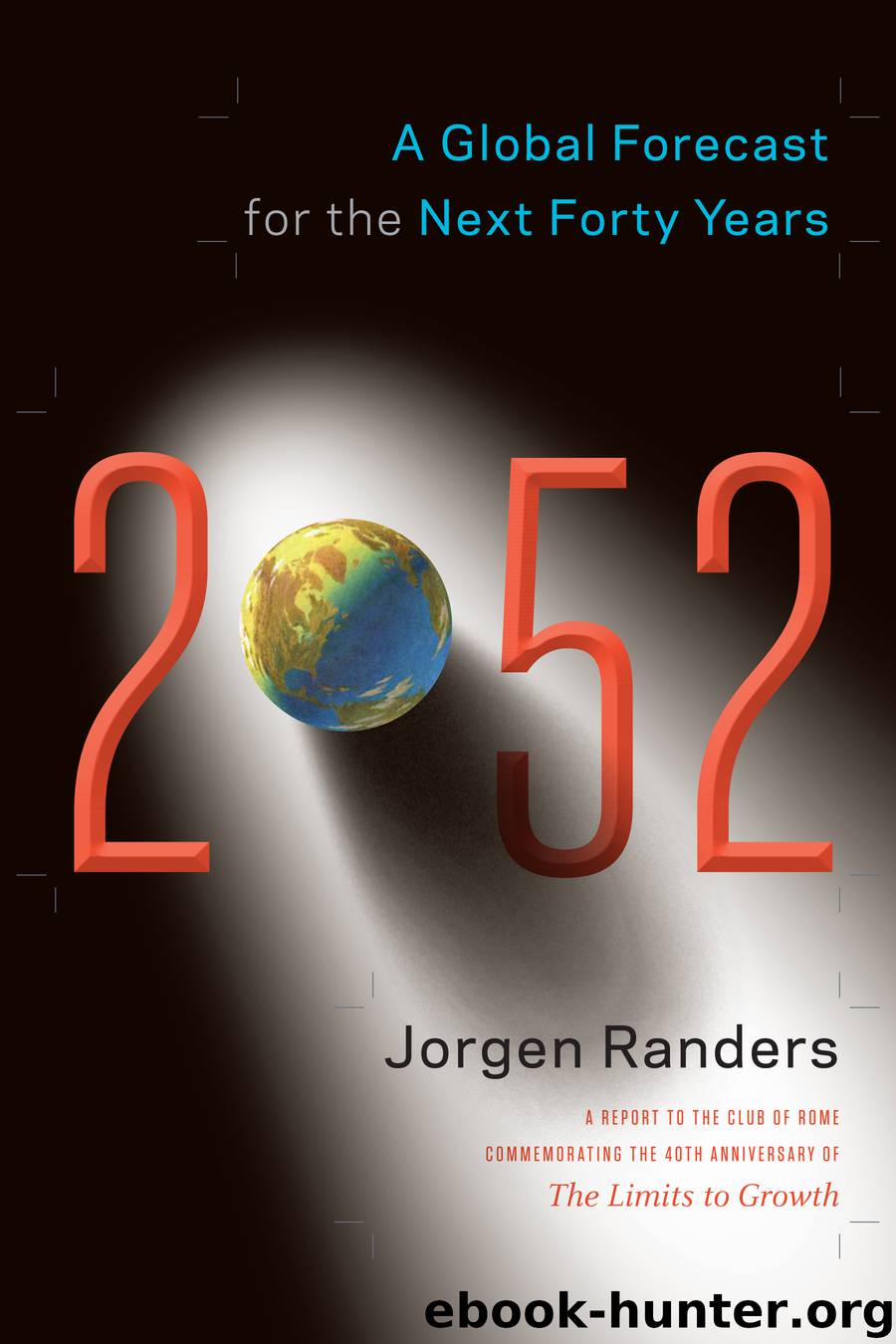
Author:Jorgen Randers
Language: ara, deu, eng
Format: epub
Publisher: Chelsea Green Publishing
Published: 2012-05-10T16:00:00+00:00
CHAPTER 8
The Zeitgeist in 2052
The rapid changes over the next forty years will have deep impacts on our cultures, our political systems, and our general frame of mind. So, what will the mood be like in the middle of the twenty-first century? By examining some core developments, we can explore the zeitgeist—the spirit—of 2052.
Fragmentation: More Focus on Local Solutions
Over the last decade or two many have come to believe that “globalization” would continue forever and ultimately create a “flat” world, with few differences across national borders. This development has been helped by institutional developments such as the World Trade Organization reducing trade barriers, and the European Union ensuring the free flow of labor and capital within Europe. But we may be seeing the limits to such flattening when the world’s more than 190 countries prove unable to reach agreement on cutting greenhouse gas emissions—in spite of nearly fifteen years of effort to replace the Kyoto protocol. Similar lack of progress characterizes the Doha trade talks on liberalization of service flows.
Although I believe globalization will wane, it won’t result in an outright decline in global trade. Trade will just grow less rapidly than optimal from a purely economic point of view. But trade will remain sufficiently free to help harmonize labor costs in the long run; free enough to continue shifting much production to low-income nations, thereby boosting their labor cost and disposable income in the longer run; and free enough to ensure that low-income countries gradually catch up with the rich countries. But as incomes rise, people will become more willing to protect the status quo. They will be more willing to sacrifice trade gains in exchange for protection of cultural traditions and national identity. Free trade will always have its enemies. And they will always have their say; not dominant, but always there, enough to weaken the invisible hand and slow economic restructuring.
The drift away from a purely economic focus in rich society is also important because it will add to all the other forces that are slowing productivity growth in these societies. Less trade means less use of comparative advantages and lower productivity growth—all else being equal.
The increased focus on cultural values in rich societies will reduce the support for common markets and the continued merger into ever larger economic units. Increased focus on soft values may even lead to fragmentation of existing institutions. The possible split of the European Union—as a consequence of very different attitudes toward life, work, and happiness in its southern and northern parts—is a case in point. At the opposite end of the income spectrum the east Asian countries are moving in the opposite direction, trying to form a Southeast Asian common market of much poorer nations.
And, on an even smaller scale, forward-thinking regions within some nations will increasingly focus on managing their inevitable degrowth. They will try to build regional resilience in the face of global economic unrest and dwindling access to cheap energy. And to do so, they will organize systems that rely on local food, local energy, and programs that strengthen regional and local economies.
Download
This site does not store any files on its server. We only index and link to content provided by other sites. Please contact the content providers to delete copyright contents if any and email us, we'll remove relevant links or contents immediately.
International Integration of the Brazilian Economy by Elias C. Grivoyannis(111078)
The Radium Girls by Kate Moore(12036)
Turbulence by E. J. Noyes(8057)
Nudge - Improving Decisions about Health, Wealth, and Happiness by Thaler Sunstein(7712)
The Black Swan by Nassim Nicholas Taleb(7137)
Rich Dad Poor Dad by Robert T. Kiyosaki(6646)
Pioneering Portfolio Management by David F. Swensen(6305)
Man-made Catastrophes and Risk Information Concealment by Dmitry Chernov & Didier Sornette(6028)
Zero to One by Peter Thiel(5808)
Secrecy World by Jake Bernstein(4756)
Millionaire: The Philanderer, Gambler, and Duelist Who Invented Modern Finance by Janet Gleeson(4482)
The Age of Surveillance Capitalism by Shoshana Zuboff(4310)
Skin in the Game by Nassim Nicholas Taleb(4257)
The Money Culture by Michael Lewis(4212)
Bullshit Jobs by David Graeber(4197)
Skin in the Game: Hidden Asymmetries in Daily Life by Nassim Nicholas Taleb(4012)
The Dhandho Investor by Mohnish Pabrai(3775)
The Wisdom of Finance by Mihir Desai(3754)
Blockchain Basics by Daniel Drescher(3586)
